
This page describes the work of the group of Marc Stamminger.
Click here to learn about the work of Bernhard Egger’s group.
Point-Based Novel View Synthesis and Reconstruction
Point-Based scene representations are a powerful scene representation, both for novel view synthesis and 3D reconstruction. Their lack of geometry enable fast scene optimization, scene completion, and rendering, but at also present particular challenges. Our research focuses on real-time methods using such point-based representations for different applications in visual computing, from novel view synthesis to 3D reconstruction.
- , , :
ADOP: Approximate Differentiable One-Pixel Point Rendering
In: Acm Transactions on Graphics 41 (2022), Article No.: 99
ISSN: 0730-0301
DOI: 10.1145/3528223.3530122
URL: https://www.lgdv.tf.fau.de/?p=2288
BibTeX: Download
- , , , , :
VET: Visual Error Tomography for Point Cloud Completion and High-Quality Neural Rendering
Siggraph Asia 2023 (Sydney, December 12, 2023 - December 15, 2023)
In: ACM SIGGRAPH Asia 2023 Conference Proceedings 2023
DOI: 10.1145/3610548.3618212
URL: https://www.lgdv.tf.fau.de/?p=2638
BibTeX: Download

- , , , :
NePO: Neural Point Octrees for Large-Scale Novel View Synthesis
In: Computer Graphics Forum (2025)
ISSN: 0167-7055
DOI: 10.1111/cgf.70287
URL: https://nolewi.github.io/nepo/
BibTeX: Download

- , , , , , :
Multi-Spectral Gaussian Splatting with Neural Color Representation
In: Computer Graphics Forum (2026)
ISSN: 0167-7055
DOI: 10.1111/cgf.70337
BibTeX: Download

- , , , , , :
Multi-Spectral Gaussian Splatting with Neural Color Representation
In: Computer Graphics Forum (2026)
ISSN: 0167-7055
DOI: 10.1111/cgf.70337
BibTeX: Download

- , , , , , , , , :
Efficient Perspective‐Correct 3D Gaussian Splatting Using Hybrid Transparency
In: Computer Graphics Forum (2025)
ISSN: 0167-7055
DOI: 10.1111/cgf.70014
BibTeX: Download

- , , , , , :
EnvMap-GS: two-stage outdoor Gaussian reconstruction with background-to-environment map baking
In: Visual Computer 42 (2026), Article No.: 416
ISSN: 0178-2789
DOI: 10.1007/s00371-026-04593-w
BibTeX: Download
Real-Time 3D Reconstruction
Reconstructing 3D models from images is a long standing research problem. The wide availability of depth cameras and advances in deep learning have pushed the field enormously in the last years. Our group’s research in this area is focused on real-time methods, that reconstruct a 3D-scene on the fly from video and/or depth streams.

- , , , , :
LiveNVS: Neural View Synthesis on Live RGB-D Streams
Siggraph Asia 2023 (Sydney, December 12, 2023 - December 15, 2023)
In: ACM (ed.): Siggraph Asia 2023 Proceedings 2023
DOI: 10.1145/3610548.3618213
URL: https://arxiv.org/abs/2311.16668
BibTeX: Download

- , , :
Low-Latency Real-Time Volumetric Reconstruction for Interactive and Dynamic Stage Productions
10th International Conference on Movement and Computing, MOCO 2026 (Montpellier, FRA, April 23, 2026 - April 25, 2026)
In: Proceedings of the 10th International Conference on Movement and Computing, MOCO 2026 2026
DOI: 10.1145/3802842.3802883
BibTeX: Download

- , , , , :
Fus3D: Decoding Consolidated 3D Geometry from Feed-Forward Geometry Transformer Latents
European Conference on Computer Vision (ECCV 2026) (Malmö, September 8, 2026 - September 12, 2026)
DOI: 10.1007/978-3-032-37167-6_33
URL: https://lorafib.github.io/fus3d/
BibTeX: Download
Imaging Radar – Forward and Inverse Simulation
Radar uses light with invisible frequencies. Imaging radars use arrays of sending and receiving antennas to reconstruct images of their environment. Simulating such radars has many similarities with physically based rendering, but there are also major differences. So, for radar phase is more important than amplitude or brightness, polarization plays an important role, and image formation is totally different from normal cameras. In our research, we look at efficient algorithms for the simulation of such imaging radars, and at its inversion for advanced 3D scene geometry and material reconstruction.

- , , , , , , :
Inverse Rendering of Near-Field mmWave MIMO Radar for Material Reconstruction
In: IEEE Journal of Microwaves (2025), p. 1-17
ISSN: 2692-8388
DOI: 10.1109/JMW.2025.3535077
URL: https://github.com/nihofm/inverse-radar-rendering
BibTeX: Download

- , , , , , :
MAROON: A Dataset for the Joint Characterization of Near-Field High-Resolution Radio-Frequency and Optical Depth Imaging Techniques
In: Acm Transactions on Graphics 45 (2026), Article No.: 23
ISSN: 0730-0301
DOI: 10.1145/3796224
BibTeX: Download

- , , , , :
MM-2FSK: Multimodal Frequency Shift Keying for Ultra-Efficient and Robust High-Resolution MIMO Radar Imaging
In: IEEE Journal of Microwaves (2026)
ISSN: 2692-8388
DOI: 10.1109/JMW.2026.3713325
BibTeX: Download

- , , , , , , :
High-Fidelity Near-Field mmWave MIMO Radar Simulation via Polarized Path Tracing
In: IEEE Journal of Microwaves (2026), p. 1-16
ISSN: 2692-8388
DOI: 10.1109/JMW.2026.3719794
BibTeX: Download
Virtual and Extended Reality – Mixing Real and Digital Worlds
In virtual reality the user is immersed into a virtual environment, in extended reality, real and digital worlds converge. In our research, we look at different variants of virtual and extended reality. We explore real-time rendering algorithms for virtual reality, look at projection mapping techniques to augment real-world objects with virtual content, and develop novel setups to augment live stage performances.

- , , :
VR-Splatting: Foveated Radiance Field Rendering via 3D Gaussian Splatting and Neural Points
In: Proceedings of the ACM on Computer Graphics and Interactive Techniques 8 (2025), Article No.: 18
ISSN: 2577-6193
DOI: 10.1145/3728302
URL: https://linus-franke.com/vr_splatting/
BibTeX: Download
- , , , , , :
EnvMap-GS: two-stage outdoor Gaussian reconstruction with background-to-environment map baking
In: Visual Computer 42 (2026), Article No.: 416
ISSN: 0178-2789
DOI: 10.1007/s00371-026-04593-w
BibTeX: Download

- , , , :
Content-Aware Brightness Solving and Error Mitigation in Large-Scale Multi-Projection Mapping
In: IEEE Transactions on Visualization and Computer Graphics ISMAR 2022 (2022), p. 3607-3617
ISSN: 1077-2626
DOI: 10.1109/TVCG.2022.3203085
URL: https://www.lgdv.tf.fau.de/?p=2413
BibTeX: Download

- , , , , , , , :
Projection Mapping for In-Situ Surgery Planning by the Example of DIEP Flap Breast Reconstruction
Eurographics Workshop on Visual Computing for Biology and Medicine
DOI: 10.2312/vcbm.20211354
URL: https://www.lgdv.tf.fau.de/?p=2193
BibTeX: Download

- , , , , , :
Scan&Paint: Image-based Projection Painting
2021 IEEE International Symposium on Mixed and Augmented Reality (ISMAR) (Bari, October 4, 2021 - November 8, 2021)
In: IEEE (ed.): 2021 IEEE International Symposium on Mixed and Augmented Reality (ISMAR) 2021
DOI: 10.1109/ISMAR52148.2021.00069
URL: https://www.lgdv.tf.fau.de/?p=2253
BibTeX: Download

- , , :
Learning Kinematic Machine Models from Videos for VR/AR training
3rd International Conference on Artificial Intelligence & Virtual Reality (Utrecht, Netherlands, December 14, 2020 - December 18, 2020)
In: 2020 IEEE International Conference on Artificial Intelligence and Virtual Reality (AIVR) 2020
DOI: 10.1109/AIVR50618.2020.00028
URL: https://www.lgdv.tf.fau.de/?p=2280
BibTeX: Download

- , , , , , :
Proxy Painting: Digital Colorization of Real-world Objects
In: Journal of Computing and Cultural Heritage 13 (2020), Article No.: 16
ISSN: 1556-4673
DOI: 10.1145/3377145
URL: https://www.lgdv.tf.fau.de/?p=2264
BibTeX: Download

- , , , :
Real-Time Adaptive Color Correction in Dynamic Projection Mapping
IEEE International Symposium on Mixed and Augmented Reality (ISMAR) (Recife, Brasilien, November 9, 2020 - November 13, 2020)
In: IEEE (ed.): Proceedings of the IEEE International Symposium for Mixed and Augmented Reality 2020 2020
DOI: 10.1109/ISMAR50242.2020.00039
URL: https://www.lgdv.tf.fau.de/?p=1948
BibTeX: Download
Visual Computing for Medical Applications
Imaging is a pillar of modern medicine, so visual computing has many applications in medicine. In our group, we explore visual computing approaches to support such applications, in particular human motion capture and analysis, as well as methods to reconstruct oscillating vocal folds.

- , , , :
A Unified Pipeline for Explainable Gait Analysis
International Workshop on Shape in Medical Imaging, ShapeMI 2025, Held in Conjunction with the 28th International Conference on Medical Image Computing and Computer-Assisted Intervention, MICCAI 2025 (Daejeon, September 23, 2025 - September 23, 2025)
In: Christian Wachinger, Gijs Luijten, Jan Egger, Shireen Elhabian, Karthik Gopinath (ed.): Lecture Notes in Computer Science 2026
DOI: 10.1007/978-3-032-06774-6_3
BibTeX: Download

- , , , , , , , , , , , , :
3D Body Twin: Improving Human Gait Visualizations Using Personalized Avatars
Shape in Medical Imaging (Marrakesh, October 6, 2024 - October 6, 2024)
In: ShapeMI 2024 2024
DOI: 10.1007/978-3-031-75291-9_6
BibTeX: Download

- , , , , :
Fireflies: Photorealistic Simulation and Optimization of Structured Light Endoscopy
9th International Workshop on Simulation and Synthesis in Medical Imaging, SASHIMI 2024, held in conjunction with the 27th International Conference on Medical Image Computing and Computer-Assisted Intervention, MICCAI 2024 (Marrakesh, MAR, October 10, 2024 - October 10, 2024)
In: Virginia Fernandez, Jelmer M. Wolterink, David Wiesner, Samuel Remedios, Lianrui Zuo, Adrià Casamitjana (ed.): Lecture Notes in Computer Science (including subseries Lecture Notes in Artificial Intelligence and Lecture Notes in Bioinformatics) 2024
DOI: 10.1007/978-3-031-73281-2_10
BibTeX: Download

- , , , :
Joint Segmentation and Sub-pixel Localization in Structured Light Laryngoscopy
26th International Conference on Medical Image Computing and Computer-Assisted Intervention, MICCAI 2023 (Vancouver, BC, October 8, 2023 - October 12, 2023)
In: Hayit Greenspan, Hayit Greenspan, Anant Madabhushi, Parvin Mousavi, Septimiu Salcudean, James Duncan, Tanveer Syeda-Mahmood, Russell Taylor (ed.): Lecture Notes in Computer Science (including subseries Lecture Notes in Artificial Intelligence and Lecture Notes in Bioinformatics) 2023
DOI: 10.1007/978-3-031-43987-2_4
BibTeX: Download

- , , , , , , , , , , :
ShaRPy: Shape Reconstruction and Hand Pose Estimation from RGB-D with Uncertainty
International Conference on Computer Vision (ICCV) Workshops (Paris, October 2, 2023 - October 6, 2023)
In: Proceedings of the IEEE/CVF International Conference on Computer Vision (ICCV) Workshops 2023
Open Access: https://openaccess.thecvf.com/content/ICCV2023W/CVAMD/html/Wirth_ShaRPy_Shape_Reconstruction_and_Hand_Pose_Estimation_from_RGB-D_with_ICCVW_2023_paper.html
BibTeX: Download
Digital Agriculture
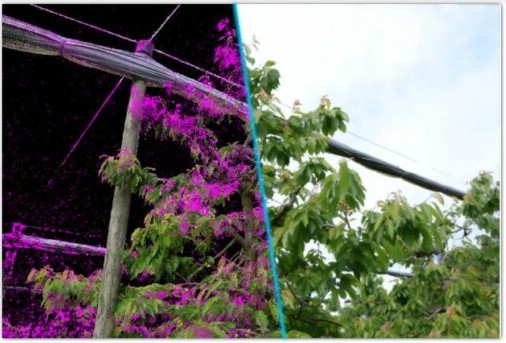
In the area of digital agriculture, the Fürth branch of our group developed methods for the generation of a digital twin of orchard trees using latest novel-view synthesis and neural rendering and reconstruction techniques.

- , , , :
FruitNeRF++: A Generalized Multi-Fruit Counting Method Utilizing Contrastive Learning and Neural Radiance Fields
IEEE/RSJ International Conference on Intelligent Robots and Systems (IROS) (Hangzhou, China, October 19, 2025 - October 25, 2025)
In: 2025 IEEE/RSJ International Conference on Intelligent Robots and Systems (IROS) 2025
URL: https://reality.tf.fau.de/publications/2025/meyer2025fruitnerfpp/meyer2025fruitnerfpp.pdf
BibTeX: Download

- , , , :
FruitNeRF: A Unified Neural Radiance Field based Fruit Counting Framework
IEEE/RSJ International Conference on Intelligent Robots and Systems (IROS) (Abu Dhabi ,UAE, October 14, 2024 - October 18, 2024)
In: 2024 IEEE/RSJ International Conference on Intelligent Robots and Systems (IROS) 2024
URL: https://github.com/meyerls/FruitNeRF
BibTeX: Download

- , , , :
CherryPicker: Semantic Skeletonization and Topological Reconstruction of Cherry Trees
IEEE/CVF Conference on Computer Vision and Pattern Recognition (CVPR) Workshops (Vancouver, Kanada, June 18, 2023 - June 22, 2023)
In: Proceedings of the IEEE/CVF Conference on Computer Vision and Pattern Recognition (CVPR) Workshops 2023 2023
URL: https://openaccess.thecvf.com/content/CVPR2023W/AgriVision/html/Meyer_CherryPicker_Semantic_Skeletonization_and_Topological_Reconstruction_of_Cherry_Trees_CVPRW_2023_paper.html
BibTeX: Download
LiDAR Resimulation
Realistic sensor simulation is mandatory for the design, evaluation, test, and training of perception for autonomous driving. We research the resimulation of LiDAR sensors, where we derive the characteristics of particular LiDAR from real test drives and generate a digital sensor twin that can be used in virtual driving environments like CARLA.

- , :
Physically Based Neural LiDAR Resimulation
28th International Conference on Intelligent Transportation Systems, ITSC 2025 (Gold Coast, November 18, 2025 - November 21, 2025)
In: IEEE Conference on Intelligent Transportation Systems, Proceedings, ITSC 2026
DOI: 10.1109/ITSC60802.2025.11423645
BibTeX: Download

- , , , , :
Synth it Like KITTI: Synthetic Data Generation for Object Detection in Driving Scenarios
5th International Conference on Robotics, Computer Vision and Intelligent Systems, ROBOVIS 2025 (Porto, PRT, February 25, 2025 - February 27, 2025)
In: Juha Röning, Joaquim Filipe (ed.): Communications in Computer and Information Science 2026
DOI: 10.1007/978-3-032-00986-9_27
BibTeX: Download

- , , , :
GAN-Based LiDAR Intensity Simulation
Proceedings of the 4th International Conference on Deep Learning Theory and Applications, DeLTA 2023 (Rome, ITA, July 13, 2023 - July 14, 2023)
In: Donatello Conte, Ana Fred, Oleg Gusikhin, Carlo Sansone (ed.): Communications in Computer and Information Science 2023
DOI: 10.1007/978-3-031-39059-3_28
BibTeX: Download

- , , , :
A Lightweight Machine Learning Pipeline for LiDAR-simulation
3rd International Conference on Deep Learning Theory and Applications (DeLTA) (Lisbon)
In: DELTA: PROCEEDINGS OF THE 3RD INTERNATIONAL CONFERENCE ON DEEP LEARNING THEORY AND APPLICATIONS, SETUBAL: 2022
DOI: 10.5220/0011309100003277
BibTeX: Download